Is There An Easy Tai Chi
Is There An Easy Tai Chi?
When starting out as a new beginner, it's hard to know where to start under the Tai Chi and Qigong umbrella. The majority of people are attracted to Tai Chi as this is the most widely known practice, with visions of moving slowly through a graceful dance like routine. Yet what most people are looking for is really Qigong, which is far less common. Why is this? This article will look at is there an easy Tai Chi.
Tai Chi
If you didn't know, Qigong is the mother of Tai Chi. Tai Chi is a much younger practice from around 400 years ago that uses the principles of Qi Gong as the foundation for a martial art. Generally the Tai Chi range of motion is smaller than Qigong. The idea is to maintain a well aligned and resilient structure throughout your movements, to be able to absorb, redirect, ground and deflect strength or power coming into your structure, "as if you were fighting". Tai Chi is much more difficult and complex to learn than Qigong as you are learning a performance, each move and transition is different. The choreography takes a lot mentally to digest and memorise, as well as physically to absorb, retain and maintain. The movements can also be demanding on the body in spite of how graceful they appear, as you basically spend that 20 minutes in a squat of varying heights.
Qigong
Qi Gong is an ancient Chinese physical exercise practice that combines the theory of Traditional Chinese Medicine (TCM) with an aligned posture, focused, dynamic movements, awareness, intent and conscious breath work. Qi Gong for health and wellbeing is often described as a health preservation exercise. As a new beginner Qigong is easier than Tai Chi to learn as the routines are shorter i.e. number of movements to learn, and each move is repeated on both sides of the body a number of times. You spend that 20 minutes moving in and out of a squat, which can be less physically demanding than Tai Chi. There is the same graceful slow movement, relaxation and coordinated breathwork. It looks less like a dance routine and more like a standing up Yoga (not the same method of movement as Yoga mind).
What new students want
Many new students come into the practice wanting a 20 minute routine they can do daily for health and wellbeing. Let's compare what it takes to learn a 20 minute Tai Chi form and a Qigong routine...
Chen Tai Chi Long Form / Laojia Yi Lu
The 74 movement long form takes about 20 minutes to perform. To learn "just" the choreography as a beginner takes 2-3 years. I'm not trying to scare anyone off, this is the reality! There are six sections, and each section is taught as a stand alone unit. A few moves are repeated thankfully. The movements consist of silk reeling, standing on one leg, stepping sideways, diagonally, forwards and backwards, punching, striking, deflecting, stomping, and kicking, with opening and closing movements, and coordinated breathwork.
Eight Pieces of Brocade Qigong
Eight movements repeated 6-8 times on each side of the body takes about 20 minutes to perform. To learn "just" the choreography as a beginner takes 2-3 months. It's the repetition of each movement that makes the difference. The focus is on opening and closing movements, basic stepping, standing stances and coordinated breathwork.
Which would you choose?
Most students when hearing that information choose to start with Qigong as an introduction to Tai Chi. Though some do jump straight into learning Tai Chi and start with the Mother Form / Chen 5 Elements Form. This beginners form takes about 3-4 minutes to perform and 6-8 weeks of learning.
Yet there is another option.
Understanding all of that, is there an easier Tai Chi?
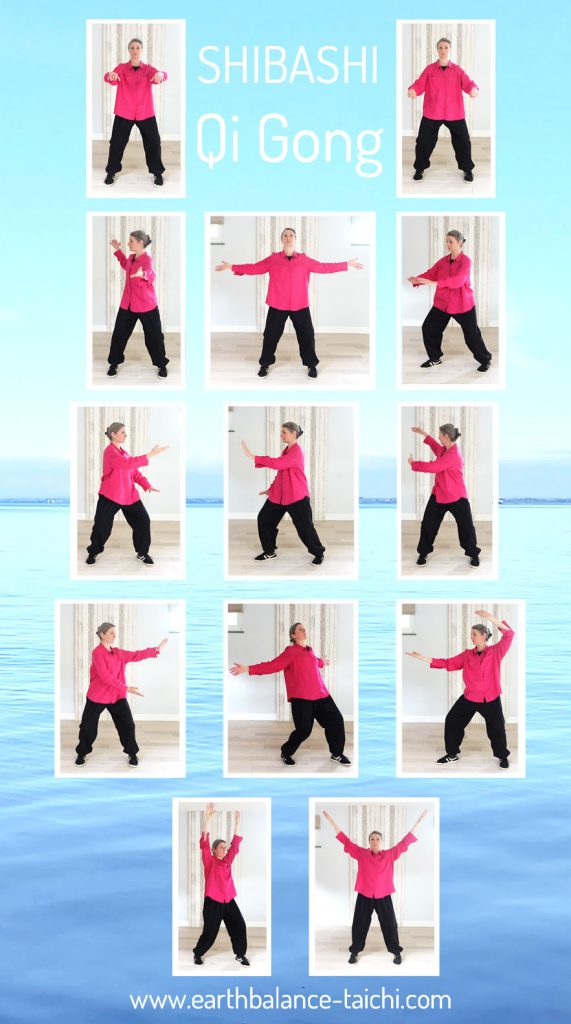
Technically no if you want to learn the traditional practice. But also yes, if you make it into a Qigong. Handily this has already been done for you with the Shibashi / 18 Form Tai Chi Qigong.
Shibashi is pronounced sher (like in sherbert) ba (sheep noise) sher (like in sherbert).
If you like the idea of Tai Chi, but don't have the time, energy, resources for the learning needed, my suggestion is to try Shibashi. It was created by Lin Housheng in 1979 and has been practised globally since. It is a well recognised and much loved Qigong routine.
It is a modern Qigong routine which draws on traditional Tai Chi movements. It is practised as a series of gentle and lengthening whole body movements that are performed equally on both sides of the body, which are coordinated with Qigong breath work techniques. The majority of the movements do not explore footwork or stepping techniques, which makes it more accessible to learn as a beginner, whilst helping to develop a good standing posture (Zhan Zhuang) and principles such as integrated strength in the lower body such as rooting, alignment and fang song (applied relaxation).
The caveat is that the Tai Chi movements have been simplified and watered down. It is easier to learn than traditional Tai Chi, however it does feel more like a Qigong routine as you have the same repetition of each movement. There are 18 movements in total, covering a number of passes (levels of learning). I teach the first three passes on Patreon: Shibashi Six Part Video Course.